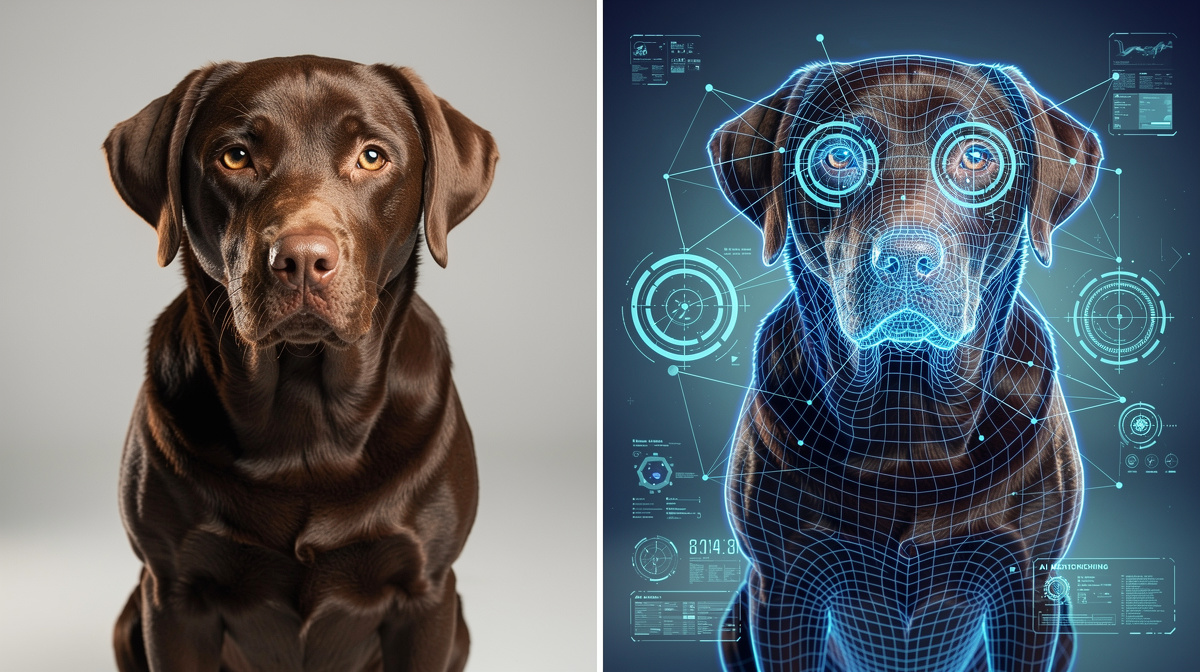
When you upload a photo of your missing dog to TierFinder, something remarkable happens in a matter of seconds: our AI creates a digital fingerprint of the image and compares it against every found-animal photo in the database. Here's how it works — without the jargon.
The problem with traditional searches
The traditional way of searching for missing pets is text-based: "Brown Labrador, medium-sized, red collar, last seen in Munich-Schwabing." The problem: everyone describes a pet differently. What you call "brown" is someone else's "beige" or "golden". What you consider "medium-sized", another person calls "large".
AI image recognition bypasses this problem entirely. It doesn't work with words — it works with pixels.
How CLIP works
TierFinder uses CLIP ViT-L/14, an image recognition model. Here's a simplified explanation:
- You upload a photo — of your missing pet or a found animal
- The AI analyses the image and creates an "embedding" — a sequence of 768 numbers that mathematically describes the image
- This embedding is compared against every other embedding in the database
- Similarity score: The higher the match, the more likely it's the same animal
Think of it like this: every pet photo is converted into a unique barcode. Then the barcodes are compared — and similar barcodes mean similar animals.
Image matching + geo matching = score
Image recognition alone isn't enough. A brown Labrador in Hamburg looks very similar to a brown Labrador in Munich — but they're probably not the same dog. That's why TierFinder combines two scores:
- Image similarity (CLIP Cosine Similarity): How alike do the animals look?
- Geographic distance (Haversine): How far apart are the reports?
A high image score + short distance = strong match. The system notifies both parties automatically.
What makes a good photo
- Front-facing photo showing the whole animal
- Good lighting (no backlighting)
- Show distinctive features (spots, scars, ear shape)
- Recent photo (fur can change seasonally)
What works less well: very dark photos, extreme close-ups, photos from behind.
Everything on our own servers
An important point: TierFinder doesn't use any cloud AI service like OpenAI or Google. Our AI models run on our own servers in Germany. Your photos are never shared with third parties. Fully GDPR-compliant.
The future: even more accurate
Currently we use a general-purpose image recognition model (CLIP). In the future we plan to fine-tune it specifically for animal features: coat patterns, face shape, body structure. Academic research (e.g. the MegaDescriptor project) shows that specialised models can significantly improve accuracy.
Why this matters
54% of all pets in Germany are not registered with TASSO. For these animals there's no chip-based identification. AI image recognition is often their only chance of being reunited with their owner. That's exactly TierFinder's mission.